Friday 19 December 2025
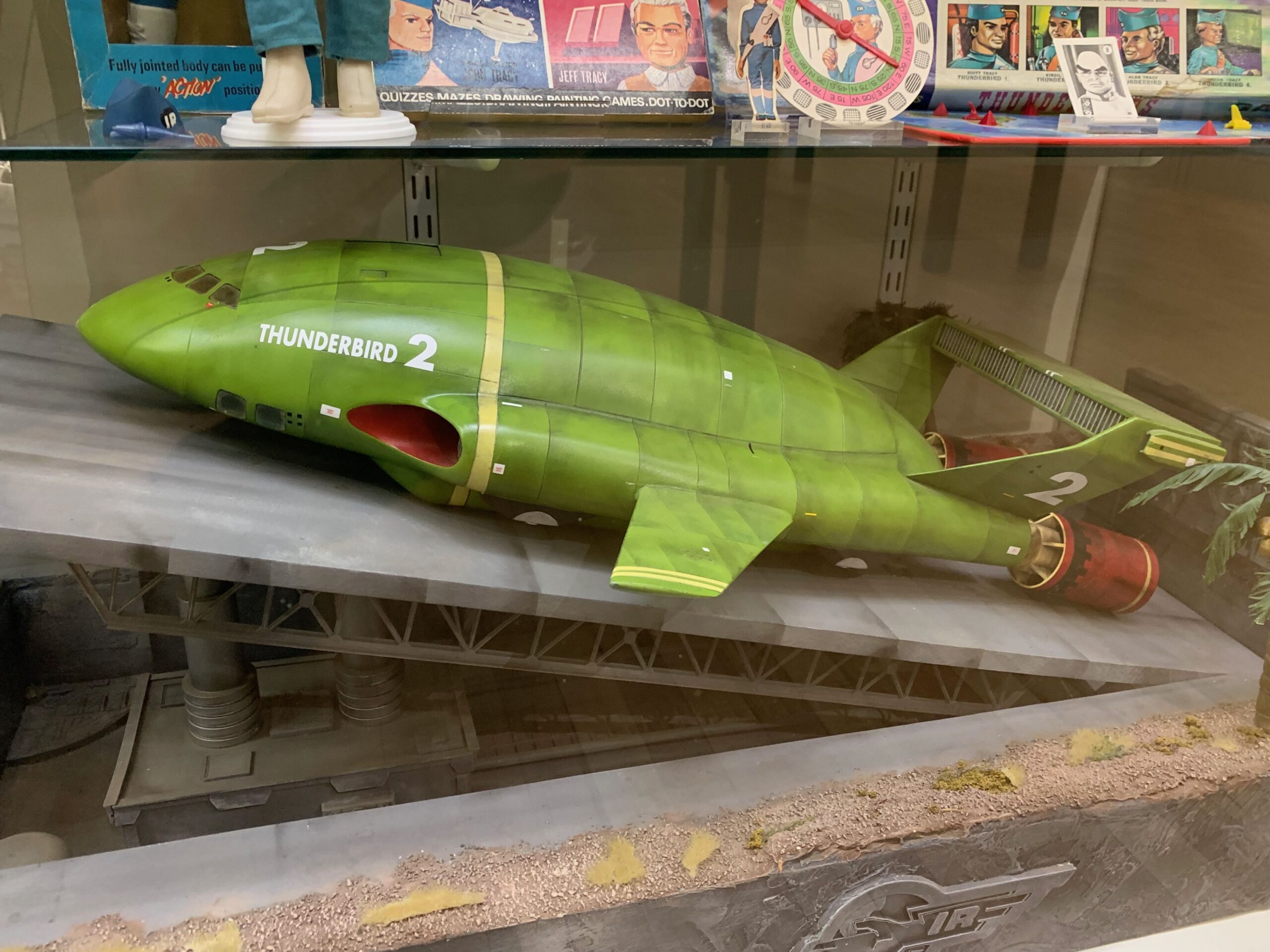
I recently entertained a visitor I didn’t know from the US, he’s actually a Brit who has lived in the US a long time. Having discovered he is an airline pilot and ex-RAF we suddenly found a common interest and passion for aviation. Almost by accident we found another one when we stopped in our walking tour of Hampstead by the blue plaque commemorating Jim Henson, creator of the Muppets. There was some to and fro between the British visitor and our American companions about ‘real puppets’ which I didn’t get and then he turned to me for help and said, ‘you must have liked Thunderbirds’. This led to an animated conversation about which Thunderbirds machine was best, which Tracy son we wanted to be, and many other important things, none of which meant anything to our younger American friends.
Why do I bring this up? Thunderbirds was created in the optimistic 1960s, a time when the space race was in full swing, and advances in technology were rapid and were bringing many benefits, albeit without recognition of the negative consequences of many of them. That recognition had to await the end of the 1960s and the early 1970s. Back then we thought technology could solve all problems, most often applied through big, centralised projects. ‘Small is beautiful’ had to wait until 1973.
I was of course an avid Thunderbirds fan. The idea of a benevolent millionaire industrialist (no doubt a billionaire in today’s money) creating amazing machines to rescue people stuck in impossible situations is a great idea. It’s a pity that none of today’s generation of billionaires- at least the well known ones – aren’t doing the same.
Thinking about Thunderbirds also makes me think of the climate crisis, as well as the numerous intersecting problems of biodiversity and environmental degradation and destruction, and the role of technology. Reversing climate change and the loss of biodiversity are two of the massive challenges we face as a species, the others include improving social inclusion through better forms of capitalism, and of course the main one which is avoiding exchanges of nuclear weapons.
We spend most of our time on working on the problems but sometimes forget why are trying to build a better world with less impact from climate change and an abundant, verdant biosphere? It is more than just survival. Survival of course is a prerequisite but on its own it isn’t enough. Surely it is about creating a world where everyone can live peacefully and comfortably and fulfil their potential. Individuals’ potential and passions cover a huge range from music to art to science to technology to exploring this planet and of course other planets.
Although high technology has lost much of the allure it held in the 1960s, and today we are better at seeing the whole range of effects it can have, (although not always better at acting upon them), advanced, and advancing, technology is inevitable and necessary to solve the nexus of problems we face and to enable people to live fulfilling lives, rather than lives of hunger, suffering, oppression and hate. The current anti-science movement is so wrong headed and very scary. We have the most amazing scientific, medical and engineering technology ever and we are on the verge of being able to treat so many diseases that ruin lives and kill hundreds of thousands, or even millions of people. The benefits of vaccination are so obvious, but now in places like South Carolina we are just starting to see what happens when you reduce the vaccination rate through mis-information and ignorance. And it is not just in medicine, in energy we are in reach of having abundant clean energy through renewables, batteries and electrification.
People sometimes ask me about the paradox about working on climate change related problems and being into aviation and space exploration. I don’t see any paradox at all. To me those interests are fundamentally human – the desire to see and go further, to explore the universe and test one’s self, and to have adventures, it is just as human as making music, creating art, or just enjoying the countryside. We need to solve the climate and other environmental problems, as well as the risk of nuclear war so that we can all fulfill our potential and follow our passions, whatever they may be.
And just in case you are wondering – my favourite Thunderbirds machine is Thunderbird 2 and my favourite Tracy brother is Virgil. Yes, it is slower than TB1 and it is a cargo vehicle, but the design and the launch sequence, starting with Virgil going down the slide from the living room, is so cool.
The title of this blog is a quote from Virgil Tracy in the Thunderbirds episode ‘Give or take a million’
Photo credit: Steven Fawkes
For those that are interested the Museum of Brands in London has an excellent Thunderbirds and Space: 1999 exhibition, which actually covers all Gerry Anderson’s shows, running until 28 February 2026. Don’t miss it.
Comments
Leave a comment for Steve
Required fields are marked *. Your email address will not be published.Dr Steven Fawkes
Welcome to my blog on energy efficiency and energy efficiency financing. The first question people ask is why my blog is called 'only eleven percent' - the answer is here. I look forward to engaging with you!
Get in touch





Tag cloud
Black & Veatch Building technologies Caludie Haignere China Climate co-benefits David Cameron E.On EDF EDF Pulse awards Emissions Energy Energy Bill Energy Efficiency Energy Efficiency Mission energy security Environment Europe FERC Finance Fusion Government Henri Proglio innovation Innovation Gateway investment in energy Investor Confidence Project Investors Jevons paradox M&V Management net zero new technology NorthWestern Energy Stakeholders Nuclear Prime Minister RBS renewables Research survey Technology uk energy policy US USA Wind farmsMy latest entries
- ‘Here we go again’ – but this time we have a choice
- The corruption of purpose in business – and how to address it
- Gee, I wish we could have a white Christmas, just like the old days….
- A look back at the last forty years of the energy transition and a look forward to the next forty years
- Domains of Power
- Ethical AI: or ‘Open the Pod Bay Doors HAL’
- ‘This is not the end. It is not even the beginning of the end. But it is, perhaps, the end of the beginning’
